
Welcome to Product! Where the roles are made up and the titles don’t matter!
If you’ve never heard of a product owner, you’ve no doubt seen the function being performed in some capacity. Pragmatic Marketing once noted that there are over 250 different job titles for the same roles and responsibilities as a product owner. Frank Caron articulated the trouble with titles well in his Medium post about the PO title. Rather than focusing on the title, let’s look at the different levels of Product and discuss some of the roles, responsibilities, and most importantly the hard and soft skills required for each of these levels.
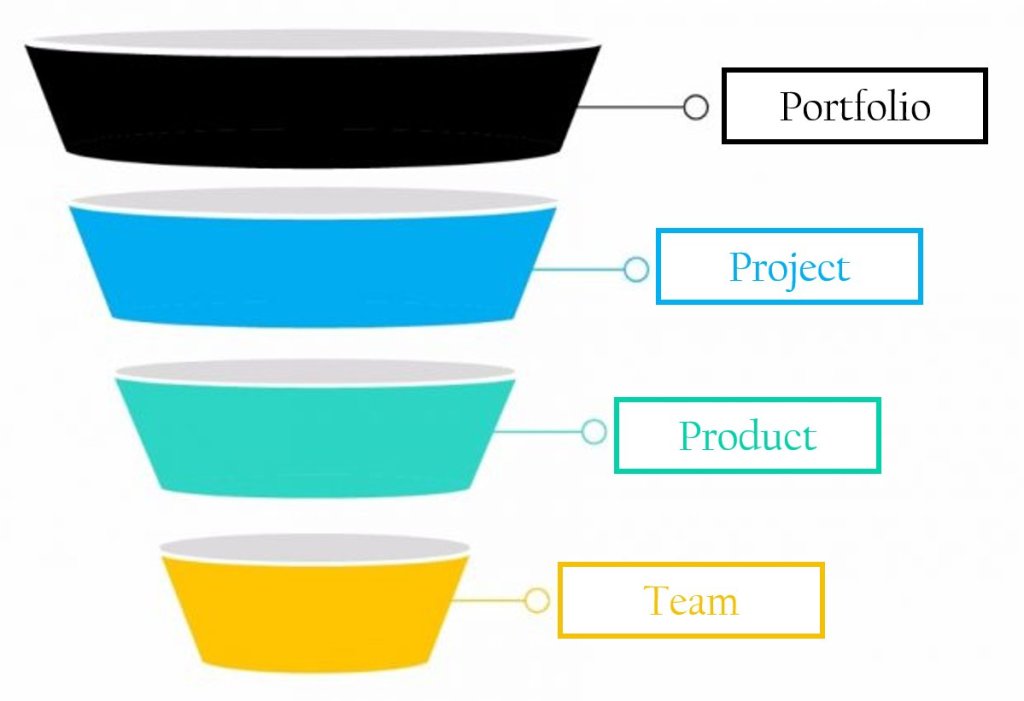
Portfolio Level: Focusing on multiple products and multiple projects. This level often oversees the overall high-level vision of a suite of products and/or projects. Most closely aligned to the high-level vision of the company or product suite, the position will look across multiple roadmaps, multiple departments and disciplines.
- Hard skills: Organizational, strategic, budget and operational, analysis, communication
- Soft skills: Relationship building, informal influence
- Titles: Portfolio Manager, Project Manager
Project Level: Focusing on a set of projects. This level can sit above or below a product level depending on the size, complexity, and structure of a product. Typically, it is above a product since it can span multiple products and be captured within the portfolio. This level often oversees projects initiatives within a framework or group and across multiple products and disciplines. Focus is more on the individual initiative and seeing it through to completion.
- Hard skills: Risk assessment, communication, organization, time management
- Soft skills: Leadership, relationship building, informal influence, attention to detail
- Titles: Project Manager, Program Manager, Product Manager
Product Level– Focusing on a specific product. This level is more focused on a specific product or product line, owning an individual roadmap and overall single product vision. Responsibilities can vary between inward team focused to the team level or outward facing with more marketing and communications focused of a product. The commonalty between the inward and outward focuses is the ability to communicate a vision of the product, identify key features and deliverable, and a deep understanding of the customer- their wants, needs, and problems.
- Hard skills: Communication, time management
- Soft skills: Informal influence, decisiveness
- Titles: Product Owner, Product Manager
Team Level– Focused on the delivery of features of a product. Focused on taking the vision and breaking down into feature sets, story writing, and planning. Sitting within the team and responsible for bringing the product vision to the team level in terms of effective story writing and acceptance criteria, being able to move multiple features, bugs, and initiatives at once, modifying backlog of work to reflect changing requirements and vision, and being able to say no.
- Hard skills: Business <-> IT translation, storytelling, written and oral skills, time management
- Soft skills: Adaptability, Decisiveness
- Titles: Product Owner, Business Analyst, Technical Writer
There are many similarities across these levels, and many of the positions require similar hard and soft skills to excel in the role. Titles don’t always reflect the role and responsibility but chances are Product people sit in one, or more likely multiple, levels above. What these levels represent is the ambiguity of the very nature of Product, but it also shows the adaptability of the role and the people who are in these roles. Depending on the company, the product, and the team make up, a well-seasoned Product person can sit at any one of the levels as they all drive to the same goal: Product success (however it is defined).
So roll the dice, throw a dart at a job tile board, and step up to a level that works for you and your organization.


 Product Offensive